

-A note from Margaret Reynolds
AI is no longer optional for leaders—but speed alone isn’t the strategy. Too many organizations are rushing to adopt AI tools without a clear connection to their strategic vision. AI isn’t the goal; it’s a means to accelerate what matters most—helping you move faster, operate more efficiently, and create greater impact while yielding a higher ROI with valued resources.
The challenge is knowing where to start. It’s tempting to follow your competitors or adopt whatever tools your industry association recommends. But your strategy isn’t identical to theirs—and your approach to AI shouldn’t be either. Likewise, choosing what’s easiest to implement often leads to incremental gains, not meaningful transformation.
Instead, the most effective starting point is where AI can create the greatest strategic advantage for your business. Our guest contributor offers a practical lens: focus on eliminating friction—across your people, processes, data, and customer experience. When you take this approach, AI becomes more than a collection of tools. It becomes an integrated, end-to-end system designed to support how your organization wins.
As I read this piece, I found myself thinking, “Yes—this is it.” If you’re looking for a thoughtful, strategic way to get started with AI, this is a perspective worth your time.

Dr. Jeanne Hurlbert, president of Hurlbert Consulting Group, uses cutting-edge survey, data, and analytics strategies (including Artificial Intelligence (AI)) to help companies attract and retain key clients, while avoiding the pitfalls of traditional market research. She will soon release her AI Automation Audit.
As Artificial Intelligence (AI) adoption proceeds at breakneck speed, predictions about who will emerge as “winners” and “losers” often assume the spoils go to those who adopt AI fastest. But substantial evidence suggests that the distribution and manufacturing companies who lead may actually be those who integrate AI most thoughtfully, rather than most quickly.
Across industries, some of the most effective AI applications have emerged not from boardrooms or executive strategy sessions but from the “front lines:” the employees who deal daily with processes and customers, those who “pick, pack, and ship”—and who encounter daily friction in doing so.
That pattern reveals a critical requirement for successful AI adoption: Your chances of deploying AI profitably depend upon assessing and addressing where friction exists in your business. And that understanding often comes not from leadership assumptions but from customers and teams. Organizations that capture and analyze those data rigorously will find the friction points and design targeted interventions—some AI-driven, others process-based—to reduce or eliminate the friction.
This isn’t just an “AI imperative.” It reflects the long-standing necessity of understanding and designing low-friction systems. We’ve seen that imperative, and its effects, at various points in history. Early in the Industrial Revolution, for example, as British manufacturing firms rushed to adopt mechanized looms and steam power, many firms failed because they simply layered new technology onto poorly designed workflows. The real “winners” led not only because they adopted early but also because they designed low-friction systems.
Similarly, although Henry Ford invented neither the automobile nor the assembly line, his exceptional skill lay in
- studying the friction in production,
- breaking it down into discrete steps, and
- redesigning the system so that each step flowed seamlessly into the next.
The 1913 moving assembly line developed not by deploying technology quickly but by eliminating wasted motion, variability, and delays. That’s what allowed Henry Ford to reduce production time dramatically.
The lesson? Advantage often goes not to those who adopt new technology the fastest but to those who understand where friction lives, gather the right data, and redesign systems around that insight. “Redesigning systems” entails applying technology—including AI—in a way that fits your work, your workers, and your customers.
In our work with distribution and manufacturing companies, we’ve seen certain core characteristics again and again:
- You care deeply about your customers,
- You take pride in doing things right, and
- You build relationships that endure, often for decades.
Yet even within strong companies, other common themes also emerge:
- A customer calls for an update—and gets transferred twice.
- An employee re-enters information that already exists somewhere else.
- A salesperson promises something—and operations scrambles to deliver.
- A leader asks a simple question—and gets three different answers.
No one designed it that way. No one wants it that way. But it happens, nonetheless. And over time, it adds up. Not as one big failure but as hundreds of small moments that make the business less efficient than it should be.
That’s friction.
As many companies turn to AI to solve these challenges, they often see improvements in such outcomes as forecasting demand, optimizing pricing, streamlining operations, improving responsiveness, and unlocking insights in ERP system data.
But a very real risk often lies undetected: If you implement AI without first assessing and addressing friction, you don’t eliminate the problem, you accelerate it. Why? Because rather than offering a “neutral upgrade,” AI amplifies what exists. AI won’t step back to say, “This process doesn’t make sense” or ask, “Why are three different teams doing the same work?” AI will take the status quo and make it run faster.
That means if your systems align, AI can multiply your advantage. But if your systems contain friction, as all too many do,
- Poor data becomes faster poor data
- Workarounds become embedded in workflows
- Miscommunication becomes automated and
- Customer friction becomes more consistent.
The result? The expected improvement remains unrealized. Why? Because AI scaled complexity and increased friction.
Strong organizations do two things before, or early in, AI adoption:
- They assess where friction exists and
- They address it intentionally.
Then—and only then—they use AI to accelerate what works. When you understand friction, you gain leverage. And when you reduce friction, you create momentum.
HOW TO ASSESS AND ADDRESS FRICTION
We developed a system to understand the four key aspects of friction reduction. The “Walk This Road System” shows how reducing friction can help you, your company, and your team walk together toward greater productivity, efficiency, and engagement. That depends upon assessing and addressing four key areas:
- Capital: Skills and Relationships That Carry the Work—Both human capital—such things as skills, abilities, training/education, problem-solving, and engagement—and social capital—connections to other people and the resources to which those connections give access—play a central role in understanding and reducing friction. Assessing human capital, though, proves more straightforward than understanding social capital. To assess social capital—where much of your AI opportunity may lie—understand such things as on whom people rely when something goes wrong or who knows how to solve problems quickly. Tap into the patterns of relationships/connections, trust and norms, cooperation, and shared goals.
- Clarity: What Matters Most? If you asked five people in your company what matters most right now, would you get five different answers, or a common theme? When priorities remain unclear, well-meaning people work hard in different directions, creating friction.
- Capacity: Systems That Can Enable or Slow Work—Capacity refers to how work gets done. Where do people pause? When do they double-check? And under what circumstances do they say, “I’ll just fix it myself?” Those moments reveal system friction.
- Collaboration: How Work Moves Across Teams—Many problems occur not within teams but between them: sales to operations, operations to logistics, customer service to the warehouse or accounting. Every handoff constitutes a potential friction point.
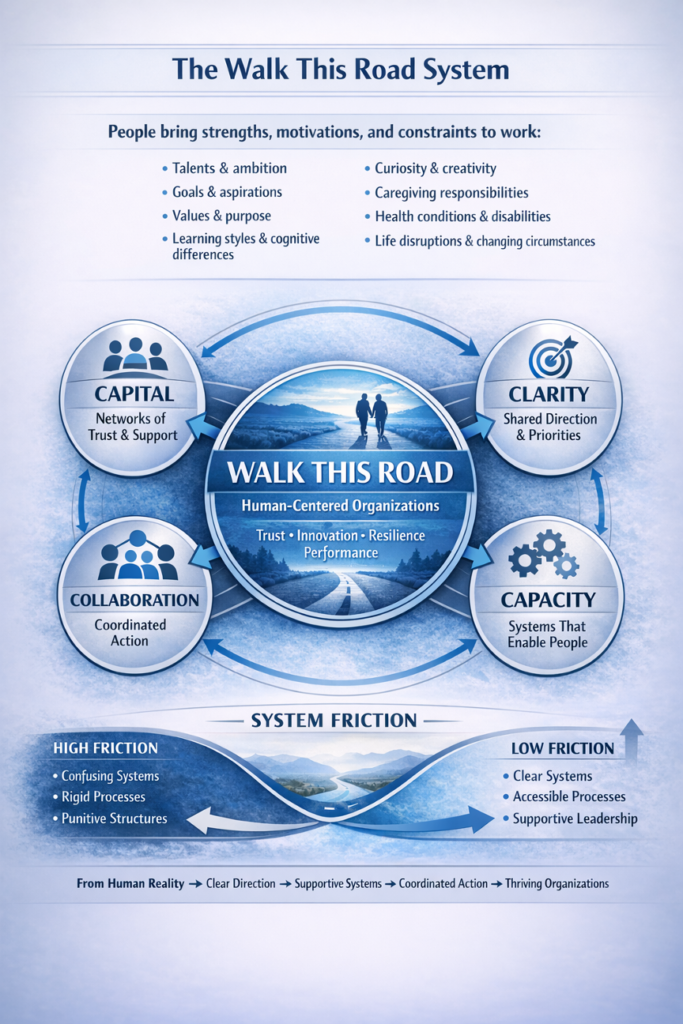
THE BENEFITS OF FOURFOLD ALIGNMENT
When these four areas align, work moves. But when they fail to align, effort increases—yet results do not. A critical issue often lurks underneath that principle: We build most systems for a version of a person who doesn’t really exist.
We tend to design systems for a mythical “standard human” who
- Possesses unlimited time,
- Processes information quickly,
- Remembers details, and
- Navigates complexity easily.
Neither your customers nor your team represent that “standard human.” Your customers operate under pressure—from their customers, their deadlines, their margins. Your employees juggle priorities, interruptions, and constraints you may not always see. And those elements can come from the job itself, from personal constraints, or both.
When systems rest on the assumption that everything is simple, they create friction for everyone. But when systems reflect who people are and how they work, communication becomes clearer, errors decrease, service becomes more consistent, and performance improves.
Organizations that become deliberate about assessing and addressing friction before, or alongside, AI adoption don’t just add technology, they change the way in which the business operates. And that produces measurable outcomes, including:
- Stronger Customer Experience—Customers receive answers faster and more consistently. They feel known, not processed.
- More Engaged Employees—Teams spend less time navigating obstacles and more time doing meaningful work.
- Better Use of Data—Information moves, decisions improve, and leaders gain confidence in the data they receive.
- Real Revenue Impact—As our clients know well: Better service drives retention, better insight drives growth, and better systems support both.
When AI operates not as a replacement for people but as a tool that helps people perform at a higher level, its value multiplies.
The difference between adding complexity and creating advantage lies in assessing and addressing friction. Growth comes not from multiplying complexity but by reducing it—allowing AI to produce gains, rather than roadblocks.